




- Published on: 2026-07-02 10:01:00
Demo Account vs Live Account Psychology: Why Winning in Simulation Isn’t Winning in Reality
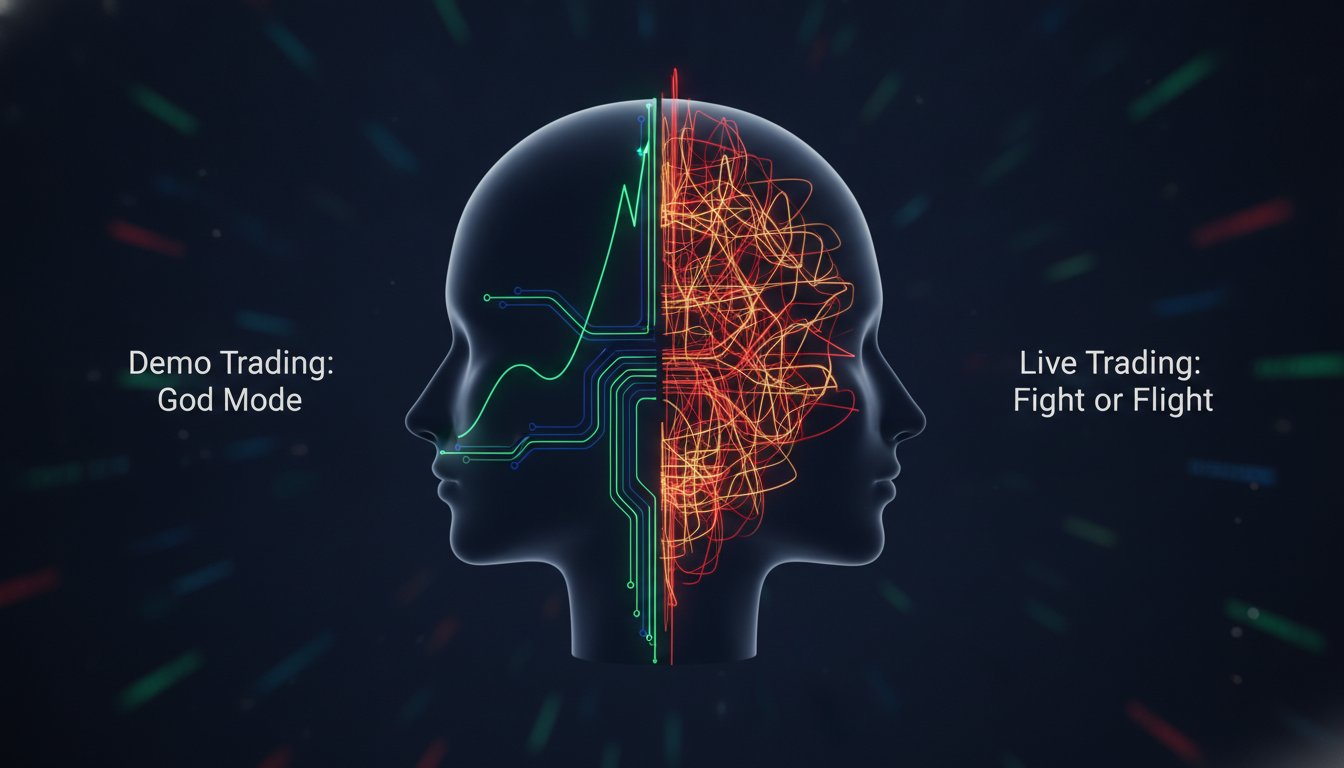
Statistics show that traders transitioning from a demo to a live account typically see their performance plummet by 20% to 30% almost instantly. You've likely felt this sting. You spend weeks perfecting a strategy in a risk-free simulator, watching your virtual balance climb, only to see those gains evaporate the moment real capital is on the line. It's an exhausting cycle that shatters confidence. The problem isn't your strategy. It's the biological shift triggered by real risk. This gap is the core of demo account vs live account psychology. Mastering it is what separates the amateurs from the elite.
You're here because you're ready to stop playing with "paper tigers" and start executing with precision. We'll show you how to bridge this divide to protect your capital and build institutional-grade discipline. You will learn the exact mental frameworks needed to handle real volatility and a concrete plan to move from a Rookie Account to a Pro Account without blowing your balance. We are diving into the science of risk and the roadmap to professional execution. Get ready to level up.
Key Takeaways
- Identify and neutralize the "God Mode" fallacy that creates reckless habits during risk-free simulation.
- Master demo account vs live account psychology by decoding how your brain’s biological "fight or flight" response disrupts live execution.
- Deploy the "Micro-Dose" strategy with a Micro Account to build emotional immunity without risking significant capital.
- Leverage Social Trading to mentor your mindset and replicate the discipline of seasoned, high-performance traders.
- Access institutional-grade infrastructure to eliminate execution anxiety and make data-driven decisions under pressure.
The Virtual Illusion: Why Demo Success Often Leads to Live Failure
A demo account is a high-tech sandbox where your only real loss is time. A live account is a high-stakes execution environment where every pip has a price tag and every mistake has a consequence. This fundamental structural difference creates a massive rift in demo account vs live account psychology. In a demo, you are playing with "house money" that doesn't exist. In the live market, you are fighting for capital preservation against global institutional forces that don't care about your feelings. The simulation is a controlled environment; the reality is a chaotic arena.
Most beginners fall victim to the 'God Mode' fallacy. When your virtual balance is infinite, you develop reckless habits that feel like skill. You double down on losing trades because there's no pain. You hold positions through massive drawdowns that would liquidate a real account in minutes. This creates a dangerous level of false confidence. You think you've mastered the market. You haven't. You've actually just mastered a video game with no "Game Over" screen. When you finally transition to a Rookie Account, the lack of infinite capital suddenly makes every red candle feel like a personal attack.
Real-world execution is messy and unforgiving. Demo accounts offer "perfect" fills at the exact price you see on the screen. Live markets involve slippage, liquidity gaps, and widening spreads during volatility. These technical frictions erode the "perfect" win rates seen in simulation. Without the biological pressure of Prospect Theory, which explains how humans feel the pain of loss twice as intensely as the joy of gain, your demo performance remains an illusion. You don't experience the "Sunk Cost Fallacy" in a demo because there's no real cost to sink. In the live market, that $100 loss feels like a hole in your pocket, not just a number on a screen.
The Purpose of the Demo: Technical vs. Emotional Training
Use your demo account to master platform mechanics. Learn how to set a Stop Loss, execute a Limit Order, and navigate the Trade Hub without hesitation. This is technical training. It's for backtesting logic and verifying that your strategy has a statistical edge on paper. It's not a tool for proving emotional readiness. Treating a demo like a game ruins your ability to respect risk. If you "play" in the simulator, you'll pay in the live market.
The Performance Gap: By the Numbers
It's common to see a 70% win rate on demo collapse to 40% in the live market. This isn't usually because the strategy failed. It's because real-world spreads and commissions eat into margins that were "free" in simulation. More importantly, the psychological weight of real money causes traders to exit winners too early out of fear and hold losers too long out of hope. Psychological Drawdown is the period of mental exhaustion and decreased decision-making quality that occurs during the first 30 days of trading real capital.
The Biological Divide: How Your Brain Processes Real Financial Risk
Trading isn't just a battle of charts. It's a biological war. When you transition from simulation to reality, your brain fundamentally changes its chemistry. This is the core of demo account vs live account psychology. In a demo environment, your prefrontal cortex remains in the driver's seat. This is the logical, calculating part of your mind. But the moment you risk real capital, the amygdala takes over. This is the 'Amygdala Hijack.' Your brain perceives a market dip not as a statistical variance, but as a physical threat to your survival.
The chemical shift is violent and immediate. Real financial risk triggers a flood of cortisol, the body's primary stress hormone. This narrows your focus and prepares you for "fight or flight," which is the exact opposite of the calm, expansive state needed for elite execution. Conversely, winning trades release dopamine. In a live account, this dopamine hit is addictive, leading to "overtrading" to chase the next high. Virtual money fails to trigger these responses because the brain's "pain centers" only activate when the stakes are tangible. You can't simulate the "Skin in the Game" effect; it only exists when your hard-earned capital is on the line.
Neurology of a Losing Trade
Your brain perceives a $100 loss as a direct blow to your security. This triggers an instinctive urge to reclaim what was lost. Revenge trading isn't a lack of intelligence; it's a biological attempt to restore your status and safety. Understanding the principles of behavioral finance is essential here. To keep your brain cool, you must implement strict rules that override these primitive impulses. High-volatility sessions require a "biological circuit breaker," such as stepping away from the screen after a specific loss threshold to let your cortisol levels normalize.
The Cognitive Bias of Virtual Profits
Transitioning from a "Play" mindset to a "Professional" mindset requires identifying your internal biases. Most traders suffer from confirmation bias in demo accounts. They ignore losses because they "don't count" while obsessing over wins as proof of their genius. This creates a "House Money" effect where you take risks you would never dream of in reality. Mastering demo account vs live account psychology means recognizing that loss aversion is your greatest enemy in a live environment. You will naturally want to hold onto losing trades longer to avoid the pain of "realizing" the loss. To bridge this gap, you must treat every virtual trade with the same gravity as a live execution. Forge your resilience by opening a Micro Account to start practicing with real, manageable stakes.
The 5 Psychological Traps of Live Trading
The transition from simulation to reality exposes five lethal traps. These aren't technical errors. They are psychological glitches that remain dormant in a risk-free environment. In demo account vs live account psychology, the stakes are the only thing that changes, yet that change is absolute. When virtual pips become real dollars, your brain stops looking for setups and starts looking for safety. This shift triggers specific, destructive behaviors that can dismantle even the most proven strategies.
- FOMO (Fear of Missing Out): In a demo, missing a trend is an annoyance. In a live account, that green candle looks like a missed mortgage payment. You execute late, entering at the exhaustion point of a trend.
- The 'Deer in Headlights' Hesitation: Your strategy screams "Buy," but you freeze. The fear of being wrong overrides your logic, causing you to miss high-probability entries.
- Premature Exit Syndrome: You see a $50 profit and close it immediately. You're terrified the market will snatch it back. This ruins your risk-to-reward ratio and ensures your losses will eventually outpace your wins.
- Revenge Trading: A real loss feels like a personal insult. You double your position size to "get even" with the market, abandoning all discipline.
- Over-Leveraging: You use excessive power to recover losses quickly. This is gambling, not trading, and it is the fastest route to a total account blowout.
These traps are deeply rooted in behavioral economics, which proves that humans are naturally wired to avoid loss more than they are to seek gain. On a demo, you are immune to these biases. In the live arena, they are your primary opposition.
The Fear of Being Wrong vs. The Fear of Losing Money
Elite traders distinguish between ego-driven mistakes and capital-driven mistakes. On a demo, you only fear being wrong. On a live account, you fear the depletion of your resources. You must learn to detach your self-worth from your Rookie Account balance. Professional trading is a game of probabilities, not certainties. If you treat every trade as a referendum on your intelligence, you'll never achieve the consistency required for a Pro Account.
Position Sizing: The Ultimate Psychological Buffer
Risk management is your emotional armor. 1% risk on a $10,000 demo feels like nothing. 1% on a $10,000 live account feels like a significant loss. This is why you must use the 'Sleep Test.' If your position size keeps you awake at night or forces you to check your phone at 3 AM, it's psychologically too large. Master your lot size to dominate your emotions. High-performance trading requires a calm nervous system, and that only comes from knowing your risk is under total control.
Bridging the Chasm: A High-Performance Transition Strategy
Crossing the gap between virtual success and real profitability requires more than just a mindset shift. It requires a tactical deployment of capital that respects the volatility of demo account vs live account psychology. You cannot expect to jump from a $100,000 demo balance to a high-stakes live environment without your nervous system rebelling. To win, you must bridge the chasm with a structured, four-step strategy designed for institutional-grade discipline.
- Step 1: The 'Micro-Dose' Approach. Stop trading virtual dollars and start trading real cents. Use a Micro Account to introduce the physical sensation of risk without compromising your financial stability.
- Step 2: Social Trading as a Mentor. Don't trade in a vacuum. Replicate the execution of seasoned authorities while you develop your own psychological resilience.
- Step 3: Gradual Scaling. Confidence is earned through repetition. Only increase your lot sizes after you have logged 20 profitable live trades using your base position size.
- Step 4: The Trading Journal. Document the 'feeling' of every trade. Did your heart rate spike? Did you hesitate? Tracking your emotional state is as vital as tracking your entry price.
This phased approach ensures that your biological response to risk remains manageable. By the time you reach larger position sizes, your brain will have already normalized the stress of live execution. You are building a foundation of steel, one trade at a time.
Leveraging Micro and Rookie Accounts
TradingPRO Rookie Accounts provide the perfect psychological middle ground for the ambitious trader. By utilizing micro-lots, you desensitize your brain to the movement of real market prices. This builds the muscle memory required for professional execution. Small deposits allow you to experience the reality of slippage and spreads without the catastrophic risk of a full account blowout. It is the smartest way to master demo account vs live account psychology while keeping your capital safe and your focus sharp.
Social Trading: Reducing the Psychological Burden
Success leaves clues. Using Social Trading allows you to observe how elite professionals handle drawdowns in real-time. This acts as a psychological buffer. You aren't just guessing; you are following institutional-grade logic. Copy Trading provides a safety net, letting you earn while you learn the nuances of the live market. You can monitor high-performance strategies through the Mastering the Social Feed tools to refine your own approach. Open your account now to start executing with the confidence of a global leader.
TradingPRO Infrastructure: Forging Discipline in the Live Market
Your environment dictates your performance. If your platform is slow, your mind will be chaotic. TradingPRO provides the institutional-grade infrastructure required to eliminate the 'tech-anxiety' that often sabotages live traders. When you move from simulation to reality, the speed of execution becomes a psychological anchor. Mastering demo account vs live account psychology requires a platform that matches your ambition. High-performance trading isn't just about your strategy; it's about the reliability of the tools you use to execute it.
Data is the antidote to emotion. Utilizing the TradingPRO Trade Hub shifts your focus from gut feelings to hard facts. Instead of making impulsive guesses based on fear, you leverage advanced analytics to make data-driven decisions. This transition is vital for conquering demo account vs live account psychology. When you trust the data, you trust yourself. You stop reacting to every minor price tick and start following a professional plan. We provide the clarity; you provide the discipline.
We provide Negative Balance Protection to remove the 'worst-case' anxiety that plagues many new live traders. Knowing your risk is capped provides the mental clarity needed to pull the trigger on high-probability setups. For those focused on precision, our ScalpX accounts offer elite execution speeds. This removes the frustration of slippage, ensuring your live fills mirror the efficiency you experienced on demo. You deserve an infrastructure that works as hard as you do.
Choosing Your Live Path
Decide which bridge fits your current psychological state. If you're still desensitizing your brain to real loss, the Micro Account is your training ground. It's the perfect environment to build muscle memory without excessive stress. Once your discipline is forged, our Pro and Scalp tiers offer the high-performance environment required for global scale. You don't have to rush the process. Open a Rookie Account and start your live journey with confidence.
Empowerment Through Education
Stay ahead of market sentiment by using the TradingPRO Blog as your daily intelligence source. Our 'Partner' ecosystem is designed to facilitate your growth from a newcomer to a seasoned authority. We don't just provide a platform; we provide a pathway to excellence. You've seen how simulation differs from reality. Now, it's time to execute. Discipline is the only bridge that doesn't collapse under market pressure. Build it with a partner that values your success as much as you do.
Forge Your Professional Edge in the Real Market
You now understand that the rift in demo account vs live account psychology is biological, not just technical. Success in simulation is a vital first step, but it isn't the final destination. To truly dominate the markets, you must transition into an environment where your decisions carry weight and your discipline is forged through real execution. Neutralize the biological traps of fear and greed by scaling gradually and trusting in data-driven tools. Professionalism is earned in the live arena, not the sandbox.
TradingPRO offers the multi-tier account structure you need to scale with total confidence. Start with micro-lot trading to desensitize your nervous system to real risk while benefiting from our robust Negative Balance Protection. From the Rookie Account to the Pro tier, we provide the institutional-grade stability and execution speed required for global success. Stop practicing and start performing in the arena that matters. Start Your Live Journey with a TradingPRO Rookie Account and take control of your financial future today. Your potential is limitless when you have the right partner at your side.
Frequently Asked Questions
Why do I win on demo but lose on live accounts?
Performance drops by 20% to 30% are standard because your brain reacts differently to real financial risk. In a demo, your logical prefrontal cortex makes the decisions. In a live account, the amygdala triggers a "fight or flight" response to potential loss. This fundamental shift in demo account vs live account psychology leads to hesitation and emotional errors that simply don't exist in a simulation.
How long should I practice on a demo account before going live?
Practice only until you master the platform's mechanics, order types, and your basic strategy logic. Staying in a simulator too long creates a false sense of security and dangerous, reckless habits. Once you can execute without technical errors, move to a Micro Account. This introduces real market friction early and prevents the "paper tiger" syndrome that ruins many high-potential traders.
What is the best account type for a beginner transitioning to live trading?
The Micro Account is the superior choice for your first live experience. It allows you to trade with real capital in cent-sized lots, providing the necessary emotional weight without catastrophic financial risk. This bridge helps you build the muscle memory required for professional execution. It is the most efficient way to normalize the stress of live market movements while protecting your primary capital.
Can demo trading actually create bad habits?
Demo trading often fosters the "God Mode" fallacy where traders take reckless risks they would never attempt with real money. You might hold losing trades indefinitely or double down because there is no physical pain of loss. These habits are lethal in the live market. High-performance trading requires a level of discipline that a risk-free environment simply cannot teach.
How do I control my emotions when trading real money?
Control your emotions by mastering your position size and adhering to strict risk management rules. Use the "Sleep Test" to ensure your risk doesn't trigger a cortisol spike; if you're constantly checking your trades, your lot size is too large. Implement a "biological circuit breaker" and use the Trade Hub for data-driven decisions. Professionalism is about removing the "guesswork" from every execution.
Is it better to start with a large or small live deposit?
Start with a small deposit to protect your capital while your nervous system adapts to real stakes. Statistics show that between 74% and 89% of retail accounts lose money in any given quarter. You don't want to be part of that group because you rushed in with too much capital. A small deposit in a Rookie Account allows you to scale up only after proving consistency.
Should I use social trading while I am still learning?
Utilizing Social Trading is a strategic move for any developing trader. It allows you to replicate the institutional-grade logic of seasoned professionals while you forge your own discipline. This acts as a psychological buffer, reducing the burden of making every decision alone. It is a high-octane way to see how elite traders handle real-market volatility and drawdowns in real-time.
How does slippage affect live account psychology compared to demo?
Slippage creates a disconnect between your expected price and your actual fill, a reality that doesn't exist in "perfect" demo conditions. This friction can lead to frustration and "revenge trading" if you aren't mentally prepared for real-world execution. Understanding this gap is a key part of demo account vs live account psychology. Use a ScalpX account to minimize this impact through elite execution speeds and precision.


