




- Published on: 2026-11-26 10:21:51
Overnight financing fees on CFDs: how much do they cost

An overnight hold can add a financing charge to your CFD costs. Overnight financing fees on CFDs generally apply when a position remains open past the broker’s daily cutoff, usually 10 PM GMT, though the cutoff varies by broker. The amount depends on the position’s notional value and financing rate, so longer holds can add up.
Spreads and commissions are easy to spot, but overnight financing fees on CFDs can be less obvious when planning a trade. This guide explains how financing is calculated, when a charge may apply, and why rates can differ for long and short positions. It also compares financing with spreads and commissions so you can see how each cost affects a trade’s overall result.
Key Takeaways
- See how an Australia 200 CFD example turns a financing rate and position value into an overnight charge.
- Understand which inputs shape the daily holding cost and why keeping a position open longer can increase the total.
- Learn why financing rates can differ between long and short trades, and how benchmark rates factor into the calculation.
- Compare overnight charges with spreads and commissions to assess the combined cost of a trade.
- Find out when brokers typically apply overnight adjustments and why the daily cutoff matters.
Example of overnight financing on an Australia 200 CFD
Consider an Australia 200 CFD position valued at 22,020. In this example, an assumed Australian deposit rate of 0.25% produces an annual financing rate of 3.25%. This shows how the instrument’s value and annual percentage rate combine to create a daily holding cost.
To follow the calculation, convert the annual rate into a daily rate, then apply it to the position value. This result assumes the inputs and daily basis stated in the example. A live trading platform may use its own calculation method and rate.
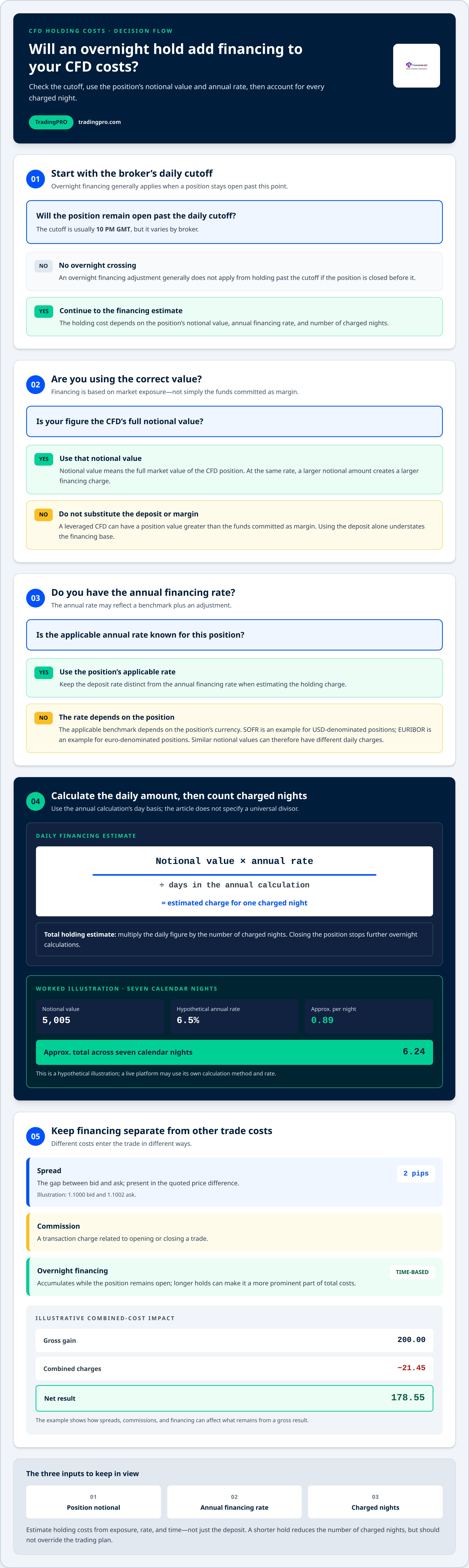
For a separate seven-night illustration, consider a CFD with a notional value of 5,005 and a hypothetical annual financing rate of 6.5%. The charge is roughly 0.89 per night, or about 6.24 across seven calendar nights. The amount accumulates while the position remains open, so the total holding cost rises with each charged night.
A UK 100 CFD can be assessed using the same steps: identify the position’s notional value, find its annual financing rate, and calculate the daily charge. Multiply that daily amount by the number of charged nights to estimate the holding cost. The UK 100 is the named instrument here, but its actual result depends on its position value and applicable rate, not the Australia 200 example’s inputs.
Keep financing separate from other trading costs. In one hypothetical breakdown, combined charges total 21.45. They reduce a gross gain of 200.00 to a net result of 178.55. The figures illustrate why a profitable market move doesn’t equal the final account result: spreads, commissions, and financing can all affect what remains.
For U.S. retail traders, these calculations explain CFD financing mechanics, not access to CFD products. Whether a trader can open a CFD position depends on the rules and product access that apply to them; the example alone does not establish availability.
Use the examples as a calculation framework, not a universal rate card. Before estimating holding costs, distinguish the deposit rate from the annual financing rate, then use the instrument’s position value and the number of charged nights. This clarifies how a longer hold affects costs without confusing market movements with the cost of keeping a position open.
How overnight CFD financing is calculated
A financing charge is based on the position’s notional value and annual financing rate. The calculation converts those inputs into a daily amount for each charged night.
Notional Value in Financing Calculations
Notional value is the full market value of a CFD position, not the deposit or margin used to open it. It matters because financing is calculated against that value: at the same rate, a larger notional amount creates a larger charge.
Daily Financing-Fee Calculation
A daily financing fee is calculated by multiplying the notional value by the annual rate, then dividing by the number of days in the annual calculation. This gives a practical estimate for one charged night. Multiply that daily figure by the number of nights the position remains open to estimate the total holding cost. Closing the position stops further overnight calculations.
Those figures show how a rate that looks modest as a percentage can become a meaningful holding cost over time.
The annual rate may reflect a benchmark plus an adjustment. SOFR is one example for USD-denominated positions, while EURIBOR is an example for euro-denominated positions. The applicable benchmark depends on the position’s currency. As a result, two positions with similar notional values can incur different daily charges if their currencies or financing rates differ.
To estimate or reduce CFD overnight financing costs, identify the position’s notional value, annual rate, and expected holding period before opening the trade. Compare the estimated total with the planned outcome. A shorter hold reduces the number of charged nights, but should not override the trading plan.
Keep the calculation separate from the deposit. A leveraged CFD can expose a trader to a position value greater than the funds committed as margin, so using the deposit alone understates the financing base. Futures have a different contract structure, so do not substitute a futures margin figure for a CFD’s notional value.
Apply the same three inputs when reviewing charges on a platform: position value, annual rate, and charged nights. A trading account registration can be a next step as you put your calculations into a trading plan.
Spread and commission costs compared with holding costs
Spreads and commissions relate to opening or closing a trade; financing accumulates while a position remains open. Holding a leveraged CFD overnight also exposes the trade to market movements and financing charges, which can compound the effect of a loss.
These costs work differently. A spread is the gap between a market’s bid and ask, while a commission is a transaction charge. For major stock index CFDs, spreads can range from 0.5 to 1.5 index points. Individual equity CFD spreads can vary by provider and market conditions. Financing, by contrast, is tied to keeping the trade open.
Position Size and Leverage Effects
Position size is the total market exposure of a CFD trade, while leverage lets a trader control that exposure with less margin. Larger positions increase the impact of spreads and commissions, and also raise financing charges because those charges relate to position value. Leverage can magnify gains and losses alike. Base your cost estimate on exposure, not just the deposit.
Holding Time and Financing Costs
Holding time is how long a CFD remains open, and it determines how many overnight financing adjustments may accrue. On a short hold, financing may be small compared with the opening spread or commission; on an extended hold, it can become a more prominent part of total costs. Compare the expected holding period with the trade’s planned outcome, and include each cost in your calculation.
For a simple spread illustration, a quote of 1.1000 bid and 1.1002 ask has a spread of 2 pips. That cost is present in the quoted price difference, unlike financing that accrues over time. A guaranteed stop is a risk-control instruction, not a replacement for assessing spread, commission, or overnight charges.
Rollover and Weekend Costs
A CFD based on a futures contract may have a rollover adjustment when an expiring contract gives way to a later one. Treat that adjustment separately from overnight financing because it relates to the contract transition. A position kept open over a weekend may also incur financing, depending on the broker’s charging schedule. Include both timing events when estimating holding costs.
To compare a trade fairly, separate entry and exit costs from ongoing charges, then assess their combined effect on the expected result. A trading account registration can be a natural next step as you apply this cost framework to your trading plan.
Long and short position financing rates
A CFD’s financing rate can depend on its direction, underlying market, and reference interest rate. As a result, long and short positions on the same instrument may have different financing charges.
For U.S.-dollar positions, SOFR is one example of a benchmark used in financing calculations. There is no single typical rate for every U.S. CFD: the benchmark, instrument, trade direction, and broker adjustment all affect the rate. Use the rate shown for the specific position when estimating its overnight cost.
A long CFD position aims to benefit from a rise in the underlying market. Its overnight financing calculation may reflect the relevant benchmark and an adjustment applied to that position. The resulting rate is applied to the exposure while the trade remains open overnight. Direction matters because a long position’s financing terms are not automatically identical to a short position’s.
A short CFD position aims to benefit from a fall in the underlying market. Its financing rate is calculated for that direction and may differ from the rate on a long position in the same instrument. Do not assume the difference is simply the benchmark interest rate. The applicable adjustment and product terms also shape the charge.
Compare both rates using the same notional value and holding period. For example, estimate the long and short financing charges separately for equivalent positions, then compare their total effect on the planned trade. This separates financing costs from any market gain or loss. In CFD trading, direction changes the exposure and can also change the financing calculation.
Closing and reopening a CFD position to avoid a financing adjustment can create other costs. Exiting and re-entering means paying the spread again, and slippage can affect the new entry price. A position closed before the applicable cutoff will not remain open for that overnight adjustment, but consider the cost of reopening alongside the financing saved.
Base the decision on the trade, not just the rate. A short-term market view may not support carrying a CFD position overnight, while a longer-term plan may account for financing as part of its expected costs. Compare the relevant long or short rate, intended holding period, and possible spread on re-entry. This gives a clearer view of how each direction affects the trade’s total cost.
When overnight CFD financing fees apply
The key trigger is time, not simply the opening of a CFD transaction. Brokers may apply an overnight financing adjustment when a position remains open past their daily cutoff, usually 10 PM GMT. The cutoff varies by broker, so a position’s status at that point matters.
For example, a trader opens an index CFD during the day and keeps it open through the cutoff. The position may receive an overnight adjustment even if it opened only hours earlier. A position closed before the cutoff generally avoids that particular charge. The distinction between opening a trade and carrying it past the cutoff is central to estimating costs.
Use the cutoff as a timing reference, not a universal clock rule. A broker may define its daily rollover using a particular time zone, and the stated 10 PM GMT time is usual, not identical across all providers. A close near the boundary can therefore be treated differently depending on the broker’s schedule and the position’s recorded status.
CFDs can cover asset classes such as indices, shares, currencies, and commodities, but the instrument’s terms determine how its adjustment is handled. The underlying asset alone does not tell you the cutoff. An index CFD and a currency CFD, for example, may follow different product terms even when both remain open overnight. Consider each instrument’s timing separately from its market exposure.
Leverage affects the exposure used in financing calculations, while the cutoff determines whether an overnight adjustment may apply. These are separate factors. A leveraged position closed before the cutoff can avoid that adjustment; a smaller position held beyond it may still incur one. Review timing and exposure together when assessing the transaction’s total cost.
Weekend holds need the same attention. If a CFD remains open across the broker’s applicable overnight period, financing adjustments may accrue according to its schedule. Do not assume that Friday’s close of business automatically removes the position from financing. What matters is whether the trade stays open through a charged period, not the day of the week alone.
Build the cutoff into your trading plan before opening a position. Note the instrument, the broker’s stated rollover time, and whether your planned exit falls before or after it. Then account for the expected number of overnight periods. This timing check helps distinguish a one-session trade from a hold that may incur further financing charges.
Use this timing framework to plan your next CFD transaction with clear eyes. Register for an account and apply the cutoff check to your trading approach.
TradingPRO
TradingPRO offers structured CFD trading through its Rookie, Micro, Pro, and Scalp Accounts, with options for varied trading approaches. Understanding how financing changes with position size, direction, and holding time can help you choose an approach that fits your plan.
Use the calculations in this guide to consider how long you expect to hold positions and how overnight charges may affect your decisions. To discuss your trading needs and account options, contact TradingPRO.
Make holding costs part of your trading plan
Turn awareness of financing into a repeatable decision habit. Before a trade, define the conditions that would justify keeping the position open, and include potential holding costs in your risk plan. After closing, review whether the actual holding period matched your expectation. This process can help refine future decisions without letting a single cost dictate your strategy.
Build the effect of overnight financing fees on CFDs into your planning, alongside your objectives and risk tolerance. TradingPRO offers Rookie, Micro, and Pro Accounts as options to consider while shaping your approach.
Ready to take your next step? Register with TradingPRO and keep developing a more deliberate trading plan. Move forward with clear priorities and decisions grounded in the costs your strategy may involve.
Frequently Asked Questions
What Are CFD Trading Costs?
CFD trading costs are charges and price effects that can reduce a trade’s net result. They may include the spread, commissions, financing for positions carried overnight, and currency conversion where relevant. For example, opening and closing an equity CFD may involve transaction costs, while keeping it open can add holding costs. Assess each cost separately, then consider their combined effect on the trade.
What are overnight financing fees on CFDs?
They are adjustments associated with keeping a CFD position open beyond a broker’s daily rollover point. The adjustment reflects financing exposure linked to the underlying instrument, rather than a separate market transaction initiated by the trader. It can be a debit or credit, depending on the position and applicable terms. For a clearer estimate, consider the instrument, trade direction, position value, and expected holding period.
How are CFD overnight financing fees calculated?
A common estimate multiplies the position’s notional value by its annual financing rate, then divides the result by the days in the calculation year. Multiply that daily estimate by the charged nights to approximate the total. For instance, a position held through several rollover points may accrue financing each time. Rates, calculation bases, and rounding can differ by instrument and broker, so use the terms that apply to the specific CFD.
How do CFD overnight fees differ for long and short positions?
Long and short CFDs can have different financing rates because the calculations reflect the position’s direction. A long position tracks exposure to a rising underlying market; a short position tracks exposure to a falling one. The rate may also reflect the relevant currency benchmark and an adjustment. Compare the applicable terms for each direction rather than assuming that reversing a trade simply reverses its financing charge.
When are CFD overnight financing fees charged?
They may be charged when a CFD remains open past the broker’s daily rollover cutoff. The usual stated cutoff is 10 PM GMT, but the applicable time varies by broker. A trade opened shortly before the cutoff may therefore be treated differently from one closed beforehand. Weekend treatment also depends on the charging schedule. The key practical detail is whether the position is still open at the relevant rollover point.
Do CFD overnight fees include broker markups or administration fees?
A financing rate may include a benchmark interest rate and an adjustment, but a separate administration fee is not automatically part of every overnight charge. The components depend on the instrument’s terms and the broker’s charging method. Check how the rate is described and whether other charges appear separately in the account statement. This helps distinguish the financing calculation from an additional fee or transaction cost.
How do overnight CFD financing fees compare with futures and options costs?
CFD financing is generally associated with keeping a leveraged position open through rollover. Futures have a different contract structure, and a futures-based CFD may involve a rollover adjustment when contracts change. Options also have a different cost structure, including the premium paid to establish a position; their value can respond to time and market changes. Compare each instrument’s full terms and holding-period costs rather than treating them as interchangeable.
What are typical overnight financing rates for CFDs in the United States?
There is no single typical rate for all U.S. CFDs. Rates depend on the benchmark, instrument, trade direction, and broker adjustment; SOFR is one example of a benchmark for U.S.-dollar positions.


