




- Published on: 2026-07-14 05:14:00
Position Trading vs Swing Trading: The 2026 Masterclass for Modern Traders
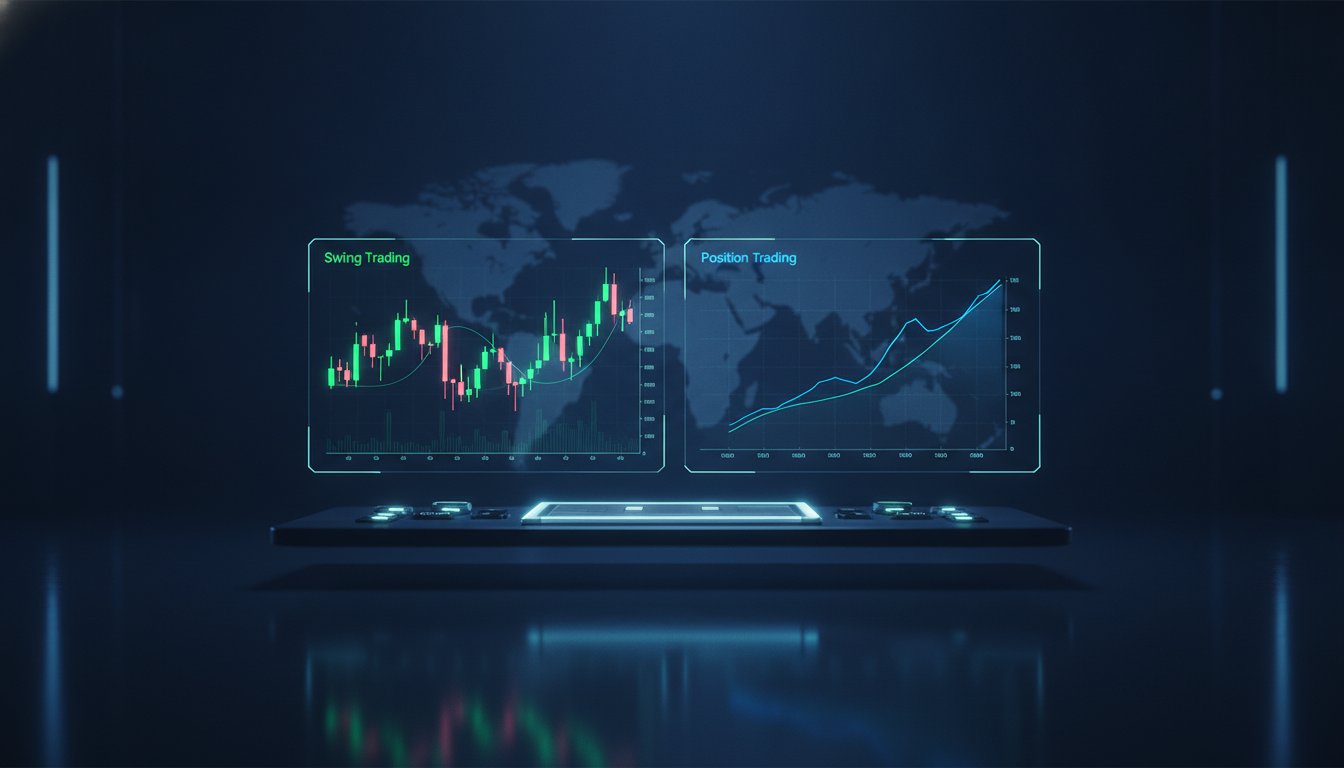
The $25,000 barrier is dead. With the elimination of the Pattern Day Trader rule this June, the landscape has shifted, yet many are still losing the battle of position trading vs swing trading by clinging to outdated habits. You've likely felt the emotional exhaustion of watching charts 24/7 only to see swap fees eat your profits. It's a high-stakes environment where over-trading leads to burnout rather than breakthroughs. You deserve a strategy that respects your time and maximizes your capital without the constant screen fatigue.
We're here to provide the definitive 2026 roadmap for your evolution. This masterclass promises to align your trading style with your professional goals, ensuring you use the right infrastructure for your specific ambition. We'll explore how to leverage our Pro and Micro accounts under the new FINRA margin framework to achieve higher precision with less effort. From tax-efficient holding periods to AI-driven decision intelligence, you're about to gain a clear decision framework for elite performance. Get ready to stop chasing the market and start commanding it.
Key Takeaways
- Define your horizon by distinguishing between the high-velocity capture of price swings and the strategic command of multi-month market trends.
- Master the analytical depth required for success, balancing technical precision with the macro fundamental insights that drive global markets.
- Evaluate the critical cost of time within the position trading vs swing trading debate, specifically focusing on swap fees and margin efficiency.
- Eliminate psychological burnout by selecting a strategy that fits your lifestyle, allowing for reduced screen time without sacrificing precision.
- Optimize your execution by matching your strategy to the correct account tier, whether you require the power of a Pro account or the focus of a Micro setup.
Defining the Horizon: Position Trading vs Swing Trading in 2026
The market doesn't care about your schedule; it only cares about your execution. In 2026, the distinction between position trading vs swing trading is the primary fork in the road for every serious market participant. Algorithmic volatility and the rise of 24/7 tokenized assets have compressed traditional timelines. A "long-term" trend that previously spanned years might now reach its peak in months. You must decide if you're hunting for immediate momentum or building a legacy on macro shifts. Success in this high-stakes environment requires a surgical understanding of your operational horizon.
The Swing Trader’s Pulse
Precision is the only currency that matters here. Swing trading is the pursuit of momentum within a secondary trend, typically lasting between 2 and 10 days. These traders ignore the long-term noise to exploit mean reversion and price "swings." It's a high-octane environment where liquidity is king. You'll find your edge in high-volume pairs like EUR/USD or gold, where technical patterns repeat with institutional regularity. Success requires a sharp eye for technical indicators and the discipline to exit before the trend exhausts itself. It's about speed, agility, and the ability to pivot as the market breathes.
The Position Trader’s Vision
Position trading is for those who play the long game. You aren't bothered by daily fluctuations or the erratic "noise" of the 1-hour chart. Instead, you're riding primary market trends that can last weeks, months, or even years. This style mirrors the institutional "buy and hold" approach but with the tactical flexibility of a modern trader. You're trading on macro-economic shifts, interest rate differentials, and geopolitical pivots. It's about capturing the "Big Move" that defines a fiscal quarter. You act as a farmer, planting your capital in fertile trends and waiting for the macro environment to mature.
Metrics of Mastery: Win Rate and RRR
Your choice of style dictates your mathematical reality. Swing traders often aim for a higher win rate, usually targeting 55% or above, because their price targets are closer to their entry points. Position traders, however, live and die by the Risk-Reward Ratio (RRR). They're comfortable with a lower win rate because their winning trades are massive. A single 1:10 RRR position can erase a dozen small losses and still leave you with a celebratory profit margin. In 2026, the most successful traders use our Trade Hub to track these metrics in real-time, ensuring their strategy remains aligned with their chosen horizon.
Analysis Methodologies: Technical Precision vs Macro Fundamentals
Your choice in the position trading vs swing trading divide dictates the weapons you carry into the market. One requires the surgical precision of a scalpel; the other, the expansive vision of a telescope. While both strategies aim for consistent ROI, the data they consume is fundamentally different. Mastering these analytical frameworks is what separates elite performers from those who merely guess. You must align your tools with your timeframe to maintain a professional edge.
Charting the Waves: The Swing Toolkit
Swing traders thrive in the data-rich environment of the 4-hour and Daily charts. Here, technical analysis (TA) is the undisputed king. You aren't just watching price; you're hunting for the exhaustion of momentum. Indicators like the Relative Strength Index (RSI) and Bollinger Bands are essential for spotting overextended swings before they snap back to the mean. Success hinges on identifying high-probability setups where the risk is tightly defined and the exit is clear. To maintain this level of precision, professional traders utilize the TradingPRO Trade Hub for real-time technical insights and institutional-grade charting. It's about finding the signal within the noise and striking with absolute confidence.
Reading the Global Narrative: Position Strategy
Position trading demands a shift from the flickering screen to the global stage. Fundamental analysis (FA) forms the backbone of your thesis. You're analyzing central bank policies from the Fed and ECB to predict long-term currency direction. Geopolitical stability and interest rate differentials are far more critical than a single candle's wick. In this arena, you care more about the "Carry Trade" and swap rates than daily pips. You're building a structural thesis based on GDP forecasts and global trade shifts. It's a high-stakes game of patience where your conviction is tested by time, not just intraday volatility.
The 2026 X-Factor: Sentiment Analysis
The modern landscape has introduced a third pillar: Sentiment Analysis. In 2026, crowd psychology moves markets faster than ever before. AI-driven tools now aggregate social data and news flow to provide a real-time pulse on market fear and greed. Whether you're timing a 3-day swing or a 6-month position, understanding the collective mood is vital. Combining TA and FA with sentiment creates a multi-dimensional edge. It allows you to anticipate shifts before they appear on the chart or in a headline. If you're ready to deploy these advanced methodologies with a partner that values your success, start your journey with a professional account today.
Capital Allocation and Risk: The Real Cost of Time
Capital is ammunition. In the position trading vs swing trading debate, your survival depends on how you deploy it. Swing traders utilize high-velocity compounding; position traders rely on structural endurance. With the elimination of the Pattern Day Trader (PDT) rule in June 2026, the barriers for smaller accounts have vanished. However, the risks have evolved. You need a strategy that protects your principal while exploiting the new risk-based intraday margin framework. Efficiency isn't just about making gains; it's about minimizing the cost of being right.
Margin isn't free. In 2026, typical brokerage margin interest rates range from 5% to over 12% annually. For a position trader holding a $50,000 debit at a 10% rate, the cost is approximately $13.70 in daily interest charges. Over months, these swap fees can erode your ROI if your thesis isn't robust enough to outpace the financing cost. Swing traders, by contrast, often exit before these costs compound, prioritizing rapid turnover and technical precision. They trade the price; position traders trade the value.
Leverage Dynamics and Account Tiers
High leverage is a precision tool for the swing trader, allowing for significant gains on small price movements. It's a high-octane approach that demands discipline. Conversely, it's a lethal trap for the position trader. Position traders prioritize capital preservation over high-frequency turnover to survive the inevitable volatility of a multi-month trend. Whether you're scaling with a Rookie Account or an institutional tier, your leverage must match your time horizon. This discipline is your shield against the "Black Swan" events that define 2026's algorithmic environment.
Managing Drawdown Over Months
Patience is a performance metric. Position trading often requires enduring weeks of "red" drawdown before the macro thesis matures. This psychological toll is heavy and requires a different mental blueprint than the quick feedback of a swing trade. Use "Time Stops" to prevent your capital from being locked in stagnant assets that fail to move within your expected window. We provide Negative Balance Protection to ensure your ambition never results in a loss that exceeds your initial deposit. It's about staying in the game long enough to win it.
Your risk per trade must reflect your chosen style. Swing traders typically adhere to the strict 1% rule, using tight stops to protect against short-term reversals. Position traders require wider stops to breathe through daily fluctuations. They trade smaller sizes relative to their total equity but target massive, multi-hundred pip moves. It's the difference between a sprint and a marathon; both require a different lung capacity and a unique approach to capital management.
The Psychological Blueprint: Which Persona Fits Your Life?
Your strategy must match your pulse. In the high-stakes choice between position trading vs swing trading, your psychological makeup is the ultimate filter. One style demands the aggressive instincts of a hunter; the other requires the disciplined patience of a farmer. If you force a strategy that contradicts your personality, the market will eventually find your breaking point. Success in 2026 is about more than just technical charts. It's about designing a trading life that fuels your ambition without causing emotional bankruptcy.
Swing traders are the market's hunters. They thrive on the adrenaline of capturing rapid momentum and seeing results within days. This path often feels like a part-time job, requiring consistent attention to the 4-hour and Daily candles. Position traders, by contrast, are the farmers of the financial world. They plant capital in fertile macro trends and wait for the season to turn. They're comfortable with silence. They don't need the constant validation of a closed trade to know they're winning. They trade for the "Big Move," not the daily dopamine hit.
The Social Trading Evolution
Modern infrastructure has created a shortcut for those who want the results without the learning curve. Many traders are now utilizing Social Trading vs Copy Trading platforms to diversify their exposure across different styles. This allows you to choose a "Master" trader who matches your desired time horizon. If you're a busy professional with a 9-to-5, you can automate the execution of a position trader's thesis while you focus on your career. It's about replicating institutional-grade precision through a frictionless, tech-forward interface. You gain the edge of a veteran while maintaining the freedom of a newcomer.
Stress Management and Market Fatigue
Burnout is the silent killer of portfolios. In the fast-moving swing environment, "FOMO" (Fear Of Missing Out) can lead to impulsive entries and over-trading. You must build a routine that prevents the charts from consuming your life. Conversely, position trading faces the "Set and Forget" myth. While it requires less screen time, it still demands the mental fortitude to hold through multi-week drawdowns. In the high-volatility landscape of 2026, staying grounded is as important as staying liquid. If you're ready to align your strategy with a partner that supports your mental and financial growth, open your professional account today and start trading with confidence.
Ultimately, your lifestyle dictates your edge. A full-time market immersion suits the swing trader who can pivot with every news spike. A strategic, long-term approach suits the visionary who values time and efficiency above all else. Recognize your persona early. When your strategy aligns with your life, the friction disappears, and peak performance becomes your new baseline. Choose the path that empowers you to lead, not just follow.
Optimizing Your Edge: Infrastructure for Your Trading Style
Execution speed is the heartbeat of the swing trader. When you're hunting for a 3-day momentum burst, every millisecond of slippage is a direct hit to your ROI. Position traders, while less sensitive to instant execution, require the institutional stability of an infrastructure that can handle multi-month exposure without a glitch. Choosing between position trading vs swing trading isn't just a mental shift; it's a hardware shift. You need an environment that scales with your ambition. Command the market by matching your account tier to your specific operational needs.
Your strategy deserves a partner that values precision. For those executing high-velocity swing setups, the ScalpX account provides the raw speed and low-latency execution required to dominate short-term price action. Conversely, position traders benefit from the robust management tools available in our Pro tier. Stay ahead of the global narrative by leveraging the TradingPRO Blog for daily market sentiment and macro-economic breakdowns. Information is the only leverage that never expires.
The Rookie Journey: Starting with Swing
The Rookie tier is your strategic launchpad. It's the perfect training ground for mastering swing momentum without the weight of excessive overhead. If you're an emerging market trader in Nigeria or Vietnam, this low-barrier entry allows you to exploit the new 2026 margin frameworks with confidence. Master the foundational entries by utilizing our Forex Trading for Beginners Guide. It's about building the discipline of a hunter before you take on the responsibilities of a farmer. Start small, trade smart, and build the consistency that leads to elite status.
Scaling to Institutional Grade
Growth demands evolution. As your capital grows, you'll likely transition from high-frequency swing trading to the strategic depth of position trading. This shift requires moving to a Pro account to access the tighter spreads and superior position management necessary for large-scale trades. The hallmark of the 2026 elite trader is the hybrid approach. You don't have to choose just one style. Use swing trading to generate immediate cash flow while maintaining long-term positions to capture the structural shifts in the global economy. This multi-asset infrastructure ensures you're always in a position of power, regardless of market conditions.
The professional roadmap is clear. Align your lifestyle with your strategy, and your strategy with our world-class infrastructure. Whether you're capturing a 48-hour swing or riding a 6-month macro trend, your success is a product of your preparation. Stop reacting to the market and start commanding it. The tools are ready. The landscape has shifted. It's time to claim your edge and join the ranks of the modern trading elite.
Command Your Financial Future
The market rewards those with a defined horizon. Whether you choose the high-velocity precision of price swings or the strategic depth of macro trends, your success hinges on elite infrastructure. The debate of position trading vs swing trading is no longer about which style is superior; it's about which one fits your psychological blueprint and professional goals. You've seen how the 2026 landscape demands both technical mastery and fundamental conviction. Now, it's time to stop observing and start executing with a partner that prioritizes your momentum.
We provide the tools for peak performance across every timeframe. Our platform delivers institutional-grade execution speed and multi-tier accounts tailored for every style, ensuring your strategy is never limited by your broker. Your security is our foundation, backed by guaranteed Negative Balance Protection to keep your ambition safe. Don't let another market shift pass you by. Start your trading journey with a TradingPRO Rookie Account today and claim your place among the modern trading elite. Your path to mastery begins now.
Frequently Asked Questions
Is position trading more profitable than swing trading?
Profitability depends entirely on your execution precision and risk management rather than the timeframe itself. Position trading captures massive, structural moves with a high Risk-Reward Ratio, while swing trading relies on the rapid compounding of smaller price waves. Neither strategy is inherently superior. The most profitable choice is the one that aligns with your capital base, psychological blueprint, and ability to remain disciplined under market pressure.
How much capital do I need to start position trading in 2026?
You can initiate a strategy with the minimum deposit of a Rookie Account, but position trading requires sufficient equity to survive multi-week drawdowns. Because this style uses wider stops to breathe through daily volatility, you must ensure your account can handle these fluctuations without breaching margin requirements. The elimination of the PDT rule this June has made entry more accessible, yet capital preservation remains your primary objective.
Can I use swing trading strategies for position trading?
Yes, you can utilize technical swing entries to time the beginning of a long-term position trade. Many elite traders use the 4-hour chart to identify a momentum shift before pivoting to a fundamental thesis for a multi-month hold. This hybrid approach allows you to enter at a surgical price point while riding the primary trend. It combines the technical precision of one style with the expansive vision of the other.
What are the risks of holding a position trade overnight?
The primary risks involve overnight financing costs and potential price gaps during market closures. In 2026, margin interest rates range from 5% to over 12% annually, meaning swap fees can erode your ROI over several months. You must also account for "Black Swan" events that cause significant slippage. We mitigate these risks by providing Negative Balance Protection, ensuring your losses never exceed your initial deposit during extreme volatility.
Which technical indicators are best for swing trading?
The Relative Strength Index (RSI), Bollinger Bands, and Fibonacci retracements are the essential tools for capturing short-term momentum. These indicators excel at identifying mean reversion and overextended price action on the Daily and 4-hour charts. When you combine these with institutional-grade data from our Trade Hub, you gain the ability to spot reversal zones with absolute confidence. Success in position trading vs swing trading often starts with mastering these technical signals.
How does social trading help in choosing between swing and position styles?
Social Trading provides a frictionless shortcut to observe how different time horizons perform in real-time. By mirroring the execution of "Master" traders, you can compare the fast-paced feedback of a swing strategy against the patient results of a position holder. It allows you to test your psychological compatibility with each style before committing significant capital. It's the ultimate tool for diversifying your exposure while building your own professional roadmap.
Do I need to check the news every day for position trading?
No, you don't need to monitor the 24/7 news cycle, but you must stay informed on major macro-economic shifts. Position traders focus on central bank policies from the Fed or ECB and quarterly GDP forecasts rather than intraday noise. Your goal is to ride the global narrative. While daily headlines might cause temporary fluctuations, your structural thesis remains anchored in long-term fundamental data and interest rate differentials.
What is the average hold time for a swing trade at TradingPRO?
The average hold time for a swing trade typically spans between 2 and 10 days. This timeframe is designed to capture a specific price move within a secondary trend without the long-term exposure of a position trade. It allows for high-frequency turnover and rapid capital rotation, which is ideal for traders using a Micro or Pro account. This duration ensures you exploit market momentum while minimizing the impact of cumulative swap fees.


