




- Published on: 2026-11-27 18:01:16
Rookie Trading Checklist for Checking Risk Before Entry

A strong rookie trading checklist before entering any position does more than signal a possible entry. Complete it before sending an order, and treat any failed check as a reason to wait or skip the trade. Two or three well-tested indicators are more useful than a crowded chart.
It’s easy to focus on finding the perfect signal. But a setup is only one part of the decision: risk, market context, emotional readiness, and your trading style matter too. A rookie trading checklist before entering any position helps you assess the full picture before committing.
This guide explains what to check, how to size a position around a planned stop, and how to reassess risk if your entry price changes. It also shows how to adapt your checks for day or swing trading, so your process fits your strategy instead of forcing every trade into the same template.
Key Takeaways
- Keep your checklist focused: use a small set of well-tested indicators, and separate the trade idea from its entry trigger and invalidation point.
- Set your stop and position size before entry, then recalculate planned risk if the entry price changes.
- Pause if emotions are driving the decision; a clear plan is easier to follow when you're calm and prepared.
- Read the instrument and market context before acting, including the broader trend, news timing, and liquidity conditions.
- Adjust your checks to your trading style: day trades and swing trades need different time horizons and market reviews.
How many indicators belong in a trading checklist?
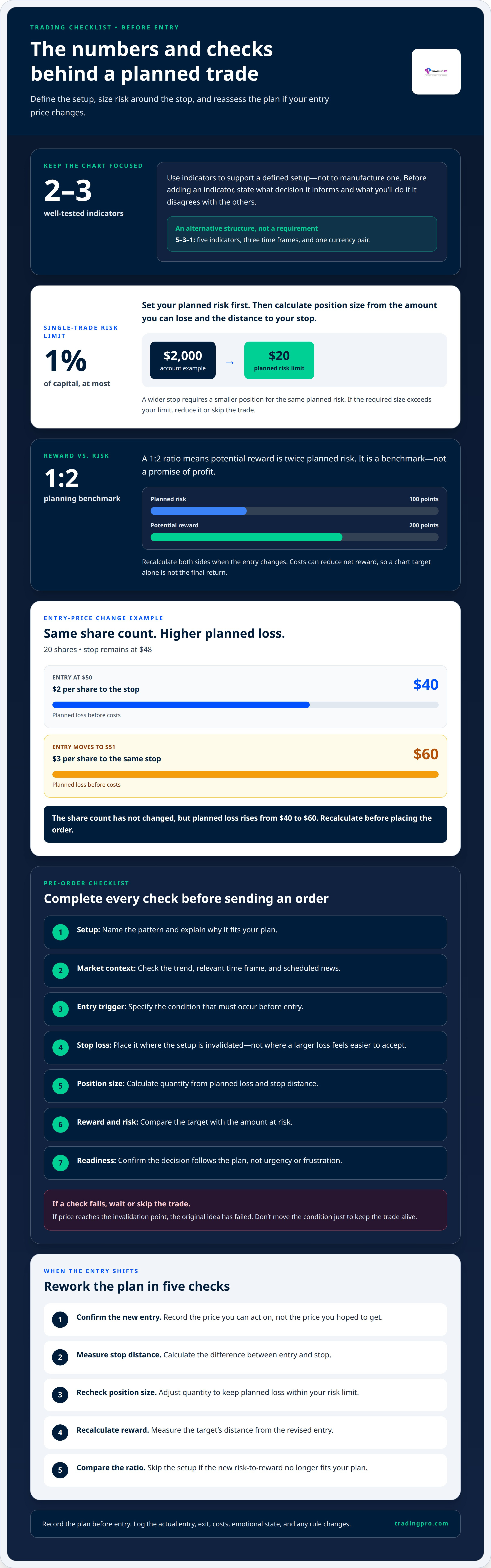
Use two or three well-tested indicators, not a crowded chart. Their purpose is to support a defined setup, not to manufacture one. The 5-3-1 rule offers a different structure: five indicators, three time frames, and one currency pair. Treat it as one approach, not a requirement. Before adding an indicator, state what decision it informs and what you’ll do if it disagrees with the others.
Separate the trade idea from its entry trigger and invalidation condition. An uptrend, for example, may support a bullish idea, but it is not an entry signal by itself. Define the entry zone, then identify the price action or technical condition that confirms an entry. Finally, set the level at which the setup no longer supports your directional bias. If price reaches that invalidation point, the original idea has failed. Don’t move the condition just to keep the trade alive.
Complete each check before sending an order:
- Setup: Name the pattern and explain why it fits your plan.
- Market context: Check the trend, relevant time frame, and scheduled news.
- Entry trigger: Specify the condition that must occur before entry.
- Stop loss: Place it where the setup is invalidated, not where a larger loss feels easier to accept.
- Position size: Calculate quantity from the planned loss and stop distance.
- Reward and risk: Compare the target with the amount at risk; a 1:2 ratio means potential reward is twice planned risk.
- Readiness: Confirm the decision follows the plan, not urgency or frustration.
Set trade risk before calculating position size. The 1% trading rule means risking no more than 1% of capital on a single trade. For a $2,000 account, that limit equals $20. If the stop is 20 pips away, size the position so a move to the stop represents the planned loss, before costs and execution differences. If the required size exceeds your limit, reduce it or skip the trade. A wider stop requires a smaller position for the same planned risk.
Record the plan before entry, then log the actual entry, exit, costs, emotional state, and any rule changes. After closing, note the result and whether you followed your process. Review entries weekly or monthly, depending on trading style. After 50+ trades, compare checklist-complete trades with skipped or rushed ones. Judge rule-following separately from profit or loss; one outcome cannot establish whether the process is sound.
Keep the checklist usable for your routine. A short, consistent process beats adding indicators without a clear decision purpose. If you’re organizing a beginner account alongside that process, see the Rookie Account details.
Recalculating risk when the entry price changes
For U.S. trades, include applicable trading rules, transaction costs, and tax treatment in your plan. These factors affect the position’s net result, so account for them before acting. A chart target is not the same as a final return.
A changed entry changes the distance to your stop and target. Recalculate before placing an order, even when the setup pattern still looks valid. For example, buying 20 shares at $50 with a stop at $48 creates a planned loss of $40 before costs. If the entry moves to $51 while the stop remains $48, planned loss rises to $60. The position now carries more risk, though the share count hasn’t changed.
Use this sequence whenever the entry shifts:
- Confirm the new entry: Record the price you can act on, not the price you hoped to get.
- Measure stop distance: Calculate the difference between entry and stop.
- Recheck position size: Adjust quantity to keep planned loss within your risk limit.
- Recalculate reward: Measure the target’s distance from the revised entry.
- Compare the ratio: Skip the setup if the new risk-to-reward no longer fits your plan.
A 1:2 risk-to-reward ratio means a potential reward of 200 points against 100 points of risk. It’s a planning benchmark, not a promise of profit. If a better entry becomes a worse fill, the reward may shrink while risk expands. Rework both sides instead of accepting the old ratio automatically. Costs can further reduce the net reward, so include them in your calculation without assuming every trade has identical costs.
Position size connects account risk to stop distance. The 1% trading rule means risking no more than 1% of capital on one trade. For a $10,000 account, that equals $100 of planned risk. If the stop distance increases, reduce the position size to keep the planned loss within that amount. If the recalculated size cannot fit your trading plan, wait or skip the trade.
Check event risk before entry. Use the issuer’s official announcement or the relevant institution’s release calendar, and record the event time and time zone. A high-priority U.S. release due in 10 minutes fails the example checklist’s news check. Major announcements, unexpected news, and low liquidity can trigger unusual movement. Don’t act until your plan accounts for the event.
Before entry, write down the revised price, stop, target, position size, risk percentage, and expected costs. If those figures no longer fit your limits, pass. When you’re ready to put a defined plan into practice, register for a trading account.
Before entering, account for applicable U.S. trading rules, transaction costs, and tax treatment in your plan. Costs can vary and reduce your net reward, so a chart target alone does not represent your final return.
Emotional readiness and trading psychology
Emotional readiness is a pre-entry check, not a feeling to ignore. Before acting, name the emotion influencing your decision: confidence, fear, frustration, or excitement. Then compare your reason for entering with your written analysis and chart setup. If your reason is “I can’t miss this move,” that’s FOMO, not a trading signal. If you’re trying to recover losses, pause rather than increasing risk to chase a result.
Use a short reset when an emotional trigger appears. Step away from the charts, reread your plan, and decide whether the original setup still exists. For example, after a trade closes at a loss, don’t immediately enter another position to erase it. A new trade needs its own analysis, entry condition, and reason to act. Missing a move also isn’t a reason to change your rules. Price may continue another 20% after you take profit, but that possibility doesn’t prove your exit was mistaken.
- Name the trigger: Write down the emotion you notice before entry. Naming fear or FOMO makes it easier to distinguish emotion from evidence.
- State the trade reason: Summarize the setup in one clear sentence. A reason tied to your plan is stronger than “the price is moving.”
- Check for urgency: Wait if you feel compelled to enter immediately. Urgency can push you to act before your entry conditions appear.
- Accept the planned outcome: Decide whether you can follow the stop and target. If either feels unacceptable, the position doesn’t fit your current readiness.
- Review recent decisions: Look at your last losing trade and note any rule changes. This helps separate a process mistake from the discomfort of a loss.
- Pause after a strong reaction: Take a break after excitement, anger, or disappointment. Returning with a clear head gives your analysis room to lead.
Make the emotional check specific. “I feel nervous” can prompt a useful follow-up: am I uncertain about the setup, or uncomfortable with the planned loss? If the setup is unclear, wait for better evidence. If the risk feels too large, reduce exposure or skip the position. Don’t widen a stop or abandon an exit plan to avoid accepting a loss. Those actions change the trade after emotions take over.
Use a journal to track your emotional state alongside trade details. Record what you felt before entry, whether you followed your plan, and what changed during the trade. After closing, note mistakes and lessons without judging the decision solely by profit or loss. Reviewing records regularly, on a schedule that suits your trading style, can reveal recurring triggers, such as rushing after a missed entry or hesitating after losses. Turn each pattern into a specific checklist rule.
Understanding the financial instrument and market context
Before entry, identify the financial instrument and its current market direction. Know what price movement the setup needs and what would make it fail. An uptrend forms higher highs and higher lows. A downtrend forms lower highs and lower lows. A sideways market stays within a range without a strong direction. Match your planned trade to the structure you can actually see.
Start with weekly and monthly charts before studying a shorter-term entry chart. If both the weekly and monthly charts for a stock are bearish, consider another stock rather than forcing a bullish idea. If the timeframes conflict, record that before choosing a direction. The broader view gives the trade idea context, while the entry chart helps locate a potential trigger.
Use a repeatable timeframe check. If your entry chart is 15 minutes, compare it with the 1-hour chart. Ask whether the higher timeframe supports the same direction or shows a major obstacle. This comparison can reveal when a short-term pattern runs against broader market structure. Don’t treat agreement as proof. Use it as context for deciding whether the setup belongs in your plan.
Indicators can help map context, but keep their role specific. The 50, 100, and 200 simple moving averages can help identify potential dynamic support. Check how price behaves around them instead of treating a moving average as an automatic entry signal. If your setup relies on support, note the relevant level and the price action that would confirm it. If price breaks the level, reassess the pattern.
Before placing an order, check what could change market activity. Major economic announcements, unexpected news, and low-liquidity periods can cause unusual price movement. Use the relevant institution’s release calendar or official announcement. Record the event time and time zone, then decide whether the trade fits your plan around that catalyst. A market can move sharply before its direction becomes clear.
- Name the instrument: Record the asset and whether your idea is long or short. This keeps the planned direction explicit.
- Mark the structure: Label higher highs, lower lows, or the range. Those observations describe the market state.
- Compare timeframes: Put the entry chart beside one timeframe above it. Note agreement or conflict.
- Locate the catalyst: Write down the event and time zone. This helps you decide whether conditions suit your setup.
- Set a decision point: Identify what must happen for entry, and what would invalidate the idea.
Finally, consider how much you’re prepared to expose to this specific market. If the chart is unclear, the instrument’s movement conflicts with your setup, or a catalyst changes conditions, wait. A useful checklist records what you observed and why the trade still fits, not merely that a familiar indicator appeared.
Adapting checks to day trading or swing trading
A structured checklist serves the same purpose across strategies, but its timing varies. Day traders focus on conditions around the planned session and entry. Swing traders assess whether a setup makes sense across longer chart intervals and while a position remains open. Match each check to your holding period, then confirm the same core points: setup, trigger, invalidation, risk, and emotional readiness.
For day trading, check the session’s market activity and relevant news before looking for an entry. A short-term chart may show a pattern, but scheduled economic announcements or low liquidity can quickly change conditions. Record the event time and time zone, then decide whether the setup remains valid. Also define when you’ll stop trading for the day. A daily loss limit gives your strategy a clear boundary after losses.
For swing trading, start with the broader structure. Compare weekly and monthly charts, then use the chart that supports your planned entry. If both weekly and monthly charts for a stock are bearish, consider another stock. Before holding a position, note upcoming events that could affect your plan. Reassess the stop and target if market structure changes instead of assuming the original setup still applies.
Use these style-specific checks before acting:
- Day-trading timing: Confirm that the entry trigger appears during the session your strategy targets. This keeps an attractive pattern outside your planned timing from becoming an impulse trade.
- Day-trading exposure: Check open positions for shared market assumptions. Positions in different instruments can still depend on the same favorable news or market direction.
- Swing-trading context: Compare the entry setup with weekly and monthly structure. This helps identify when a short-term signal conflicts with the broader trend.
- Holding-period events: Review relevant release times across the period you expect to hold. News can change volatility while the trade remains open.
- Risk limits: Apply the same planned risk percentage and position sizing method to either style. A longer holding period doesn’t justify exceeding your limit.
- Exit review: Write down what would invalidate the setup and when you’ll reassess it. This gives the trade a decision point beyond watching every price move.
Keep the process consistent, while adapting timeframes and event checks. A day trader may reassess conditions during a session; a swing trader may review them when new chart information or a scheduled event affects the plan. In either case, record the reason for any change. Don’t widen risk to avoid accepting a loss or enter just because a pattern looks familiar.
Put your chosen strategy into practice with a structured routine. Register for a trading account when you’re ready to apply your checklist to live trading.
TradingPRO: Rookie Account
TradingPRO’s Rookie Account is designed for rookies ready to apply a structured pre-trade checklist in a trading account. Use the checks in this guide to ground decisions in the setup, market context, planned risk, and emotional readiness. A checklist can guide your process, but it can’t remove market risk or guarantee a profitable result.
If you’re still shaping your approach, explore Social Trading / Copy Trading alongside your own research and risk decisions. Whichever route you consider, keep your entry rules and position sizing clear before acting. The Rookie Account is a relevant next step when you’re ready to apply your checks in practice.
To discuss the Rookie Account, contact TradingPRO.
Make your next decision deliberate
Use a rookie trading checklist before entering any position as a decision gate, not a formality. Let your journal show which parts of your process need more discipline, then refine your rules between trades, not in the heat of one. A checklist can guide decisions, but it can’t guarantee a profitable outcome.
TradingPRO offers Rookie, Micro, and Pro Accounts for different trading needs. If you’re ready to take your next step, contact TradingPRO to discuss your checklist. Keep your process clear, your decisions measured, and build confidence one planned trade at a time.
Frequently Asked Questions
Should day traders and swing traders use the same checklist?
Use the same core decision checks, then tailor the timing and chart review to your holding period. A day trader might confirm that a setup fits the current session, while a swing trader may weigh broader chart structure and events during the planned holding period. Keep entry and invalidation rules consistent, but adjust which timeframes and scheduled events you review.
How do you keep a trading checklist honest?
Record decisions before you know the outcome. Write down the setup, entry reason, planned exit, and any failed condition, including for trades you skip. Later, compare your original notes with what you actually did. If you moved a stop after entry, for example, record the reason rather than editing the original plan. This makes it easier to spot changes made under pressure.
How does trading psychology affect trading decisions?
Trading psychology can affect whether you follow your analysis or react to fear, excitement, or frustration. After missing an entry, for example, a trader may chase price without the planned signal. A journal can reveal this behavior across trades. Record your emotional state and decision before entry, then review whether emotion changed your sizing, timing, or exit. Use any recurring pattern to create a specific pause rule.
Should I trade before major news?
Enter before major news only if your strategy accounts for the event and its timing. Economic announcements and unexpected news can cause unusual market movement, while low liquidity can add uncertainty. Check the relevant release calendar, note its time zone, and decide in advance whether you’ll trade, wait, or skip. If the event makes your setup conditions unreliable, don’t force an entry just to stay active.
What happens when one check fails?
Wait or skip the trade when a required condition fails. A checklist is a decision gate, not a scorecard where several passing items cancel one critical failure. If your entry trigger appears but the planned stop no longer fits your risk limit, for example, don’t place the order. Reassess later if market conditions change, but treat it as a fresh decision.
What is the 1% rule for traders?
The 1% rule means risking no more than 1% of your trading capital on a single trade. Calculate that limit first, then choose a position size that keeps the planned loss at the stop within it. The rule concerns potential loss, not the amount invested or the position’s market value. It’s a risk-management guideline, not a promise that losses will stay within the planned amount.
What is the difference between a trading plan and a trading checklist?
A trading plan sets the framework for decisions, including objectives, risk tolerance, time horizon, and the markets or setups you intend to trade. A checklist turns that framework into questions to answer before a specific order. The plan might define which pattern you trade; the checklist confirms whether today’s chart meets its conditions. Use both to connect long-term rules with each entry decision.
What should a beginner trading checklist include before entering a position?
A beginner’s checklist should identify the instrument, setup, entry trigger, invalidation point, stop, position size, target, and relevant market events. Add a readiness check: can you explain the trade without relying on urgency or a recent win? A rookie trading checklist before entering any position should also make it clear when to pass. If a required answer is unclear, pause instead of improvising.


