




- Published on: 2026-11-24 18:01:32
What to Do After Blowing Your First Demo Profit and Reset
A reset isn’t a signal to win your profit back fast. After blowing your first demo profit, pause for a week, review your trades, and return only with a clear risk limit and smaller position size. Protect your process before pursuing another result.
It’s frustrating to watch a promising start disappear, especially when a demo account made trading feel straightforward. But a profitable stretch doesn’t prove a strategy is ready for greater risk, and a loss doesn’t mean you need to abandon it. Use the reset to spot what changed: your entries, exits, position size, or discipline.
This guide explains how to choose between simulation and a small live account, set a risk limit for your next step, and focus on following your plan instead of chasing profit. You’ll also learn to reduce position size before trading again, so you measure your return by consistent decisions, not by how quickly you recover.
Key Takeaways
- Choose between demo and live trading based on whether your recent decisions followed a repeatable plan, not just whether the account showed a profit.
- Set a clear loss boundary before entering a trade, and step away for the day after three consecutive losses.
- Use a trading log to spot recurring mistakes and measure consistency across a run of trades.
- Before returning, cut your per-trade risk by at least half and scale position size to the stop-loss distance.
- Look for patterns behind lost demo profits, including oversized positions, impulsive entries, and abandoning planned exits.
Choosing between demo and small live accounts
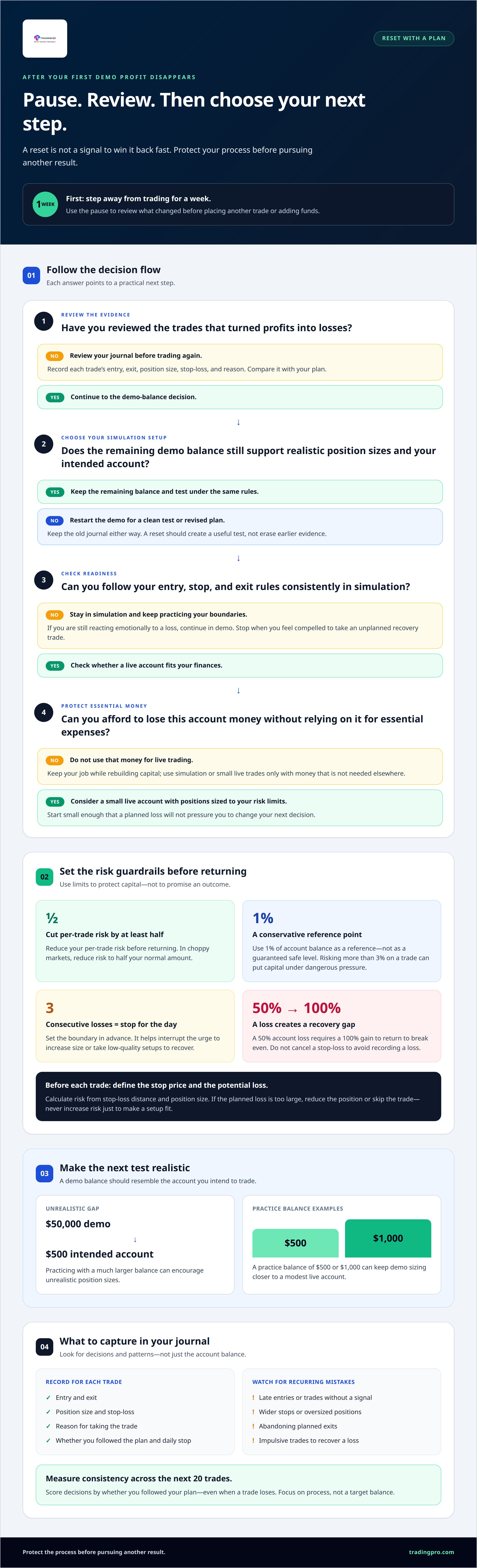
Pause for a week after an account blowup, then choose your next step based on your trading record. A useful answer to what to do after blowing your first demo profit starts with identifying what your recent trades can teach you.
-
Review Demo Trades for Mistakes
Open your journal and review each trade from the period when profits turned into losses. Record the entry, exit, position size, stop-loss, and reason for taking the trade. Compare those details with your plan: did the setup qualify, did you place the stop, and did you exit as planned? This separates a valid losing trade from an avoidable mistake.
Group trades by the decision that went wrong. For example, mark late entries, wider stops, or trades taken without a signal. Demo accounts help you practice execution and using stop-loss and take-profit orders. They also show how trade size, stop distance, spread, and leverage can affect risk, while news events can move prices. Record these observations in your journal instead of relying on memory.
-
Decide Whether to Restart the Demo
Keep the remaining balance if it still supports realistic position sizes and lets you test your strategy under the same rules. Restart when the balance no longer reflects the account you intend to trade, or when you need a clean record to test a revised plan. Preserve the old journal either way. A reset should create a useful test, not erase evidence of earlier decisions.
Take one week away from trading after an account blowup. Use the pause to review what changed before placing another trade or adding funds. If you’re still reacting emotionally to a loss, continue in simulation. A demo balance should resemble your likely live account: practicing on $50,000 when your eventual account will be $500 can encourage unrealistic position sizes.
To avoid overtrading or revenge trading, set a session limit before opening the platform. Stop when you feel compelled to take an unplanned trade just to recover. If you’re still unsure what to do after blowing your first demo profit, use your next demo session to practice respecting that boundary.
-
Choose an Affordable Live Account Size
Choose an account size you can afford to lose without depending on trading income for essential expenses. Keep your job while rebuilding capital, and use simulation or small live trades rather than money needed elsewhere. A practice balance of $500 or $1,000 can keep demo sizing closer to a modest live account.
Consider live trading only when you can follow your entry, stop, and exit rules consistently in simulation. Start with positions small enough that a planned loss won’t pressure you to change your next decision. The goal isn’t to recreate demo profit quickly. It’s to carry a disciplined process into a trading account that fits your finances.
Capital and risk management
There’s no universal demo drawdown that automatically means you must change strategy. Review the trades behind it: change your approach when repeated losses expose a flaw or you keep breaking your rules, not simply because the balance fell.
For free U.S. learning, use public investor education materials on risk and trading, then practice the concepts in a demo account. Pair each lesson with a journal entry showing how a stop, position size, and potential loss fit together.
- Set a risk limit before your next trade. Choose the amount of capital you can afford to lose, then calculate risk from the stop-loss distance and position size. The same percentage loss has a different dollar impact depending on account size. The percentage matches, but the dollar impact changes with account size.
A 50% account loss requires a 100% gain to return to break even. That recovery gap is why protecting capital matters more than trying to win back a lost demo profit quickly. Don’t cancel a stop-loss to avoid recording a loss.
- Keep per-trade exposure controlled. Use 1% of account balance as a conservative reference point, rather than treating it as a guaranteed safe level. Risking more than 3% on a trade can put capital under dangerous pressure. In choppy markets, reduce risk to half your normal amount, and keep the same rule across winning and losing trades.
Before entering, identify the stop price and how much you’d lose if it’s reached. If the planned position makes that loss too large, reduce the position or skip the trade. Never increase risk just to make a setup fit.
- Set a daily stop and honor it. Stop trading for the day after three consecutive losses. A daily boundary interrupts the urge to increase position size or take low-quality setups to recover. You can also define a maximum daily loss or trade count in advance, then end the session when either limit is reached.
Write the stop condition in your journal before trading. Record whether you followed it, not just the day’s profit or loss. That evidence helps distinguish a strategy problem from a failure to control risk.
- Protect capital you need outside trading. Don’t use money needed for bills or other essential expenses, and don’t add funds to chase a loss. Keep a job while rebuilding capital, and use simulation until your risk rules feel repeatable. When you’re ready to consider a live account, review the account registration options alongside your planned risk limits.
Risk management can’t eliminate losing trades. It can keep one trade, one session, or one emotional decision from dictating your next move.
Focusing on process rather than profit
Use the next 20 trades to test whether you can follow your plan consistently, not to chase a target balance. Score each trade by its decisions, even when the outcome is losing.
- Define a process score before opening charts. Write down the conditions that qualify a trade, the entry signal, the stop, and the exit rule. Turn each condition into a yes-or-no check. For example, a trade that meets the setup but hits its stop can still be valid execution. A winning trade taken without a signal is still a rule break.
Use the same checklist for every setup. This keeps profit from becoming your only measure of performance and makes your review consistent across different market conditions.
- Record decisions as well as results. For each trade, note the setup, entry, exit, planned risk, and whether you followed the rules. Add a short reason for any deviation, such as entering before the chart confirmed your signal. That detail can reveal a pattern that a balance curve hides.
At the end of each session, separate valid losses from avoidable errors. A losing trade that followed the plan gives you different information from a loss caused by moving a stop or taking an unplanned entry.
- Practice the limits you intend to use. If your rule is five trades per day, apply that limit during demo trading instead of treating simulation as unlimited practice. Stop when you reach the cap, even if the last trade lost or another setup appears. The point is to rehearse the decision boundary before pressure builds.
Review your charts after the session. Mark where your planned entry and exit occurred, then compare them with your actual actions. This makes it easier to spot repeated early exits or late entries without relying on memory.
- Set a process goal for a defined run. Aim to execute your plan on 20 consecutive trades without breaking its rules. Track each trade as pass or fail on execution, then review the first rule break before continuing the sequence. Don’t reset the count because a valid trade lost.
Watch for profit-driven changes, too. If you’re up $500 and close a position earlier than your exit plan allows, record the deviation. Judge the decision against the written rule, not the profit you kept or the further gain you missed.
Keep a trading log alongside your checklist, recording each trade and reviewing it for recurring mistakes. This can help distinguish an isolated lapse from a habit that keeps affecting your decisions. Note what happened before, during, and after the trade, including when your actions began to diverge from your plan. The goal isn’t to criticize every imperfect outcome, but to make your decisions easier to examine later.
Review your actions regularly and look for patterns across trades. You may find that the same deviation appears under similar conditions, or that a particular mistake keeps recurring despite good intentions. Use those observations to choose what to focus on in your next review, then keep recording your actions. A clear record gives you a basis for assessing behavior, rather than relying on memory or letting one result define your judgment.
Reducing position risk before returning
- Cut your planned per-trade risk by at least half. Treat this as a reset rule, not a temporary attempt to win losses back. If your previous plan risked 4% of the account on one trade, halving it means 2%. That example shows the adjustment; it isn’t a target every trader should adopt.
Write your new maximum risk beside your setup criteria before trading. Keep it unchanged after a win or a loss. If the smaller risk makes a trade feel less exciting, take note: your previous position size may have made each outcome too consequential.
- Calculate position size from the stop, not from your profit goal. First choose the price at which the trade idea is invalid. Then work out how much the planned position would lose if the price reaches that stop. If the loss exceeds your reduced limit, lower the position size or pass on the trade.
For example, a wider stop requires a smaller position if the maximum dollar loss stays fixed. A tighter stop may allow a larger position, but only if the setup supports that stop. Don’t move the stop closer just to justify a bigger trade. The stop should reflect the setup, and the position should fit the risk limit.
- Return at a fraction of your intended position size. Start with 25% of your planned position size for the first week or two. This gives you room to practice live execution while keeping exposure lower than your intended level. Keep the same entry, stop, and exit rules you practiced in simulation.
Record each trade’s intended size, actual size, stop distance, and result. If a smaller position still triggers impulsive exits or extra trades, pause live trading and return to simulation. Position size should support your plan, not push you to change it.
- Use a clear return-to-normal test. Increase size only after you’ve shown that you can maintain reduced risk and follow your exit rules across a consistent run of trades. Don’t treat one profitable session as proof. Check whether your process held through winning and losing trades, including moments when the market moved quickly.
Before each entry, work out the planned loss and ask whether you can accept it without changing the stop. If the answer is no, reduce the size again or skip the setup. The purpose is controlled execution, not a fast recovery. Keep the risk limit visible in your journal so every trade starts with the same boundary.
The author recommends cutting per-trade risk by at least half when returning to the market. Make that boundary easy to apply: decide how much you can lose before considering a possible gain, and check that the planned position respects it. If you can’t verify the loss clearly, leave the trade until the calculation is clear. Keep this decision separate from your confidence in the setup: conviction doesn’t change the amount you’ve agreed to risk. A return is successful when your choices stay within that limit, even if an individual trade doesn’t work out.
What are the most common reasons traders lose demo profits?
- Check whether your demo balance encouraged unrealistic sizing. A strategy tested on a $50,000 demo may feel manageable, but the same position can be unsuitable for a planned $500 live account. Large practice balances can make ordinary price swings seem insignificant. Compare your demo position sizes with the account you expect to trade, then assess whether those sizes remain practical.
For example, a strong demo run, such as an 80% win rate over three weeks, is only a limited sample. It doesn’t establish that the strategy will keep performing or that your position size fits another account.
- Review whether leverage magnified routine market moves. A small price change can have a greater effect on account equity when the position is large relative to available capital. Review each trade’s size, stop distance, and leverage together. If a modest move caused an outsized account swing, the problem may be exposure rather than the entry signal.
Compare trades with similar setups. If the outcome changed sharply when you increased size, record it as a sizing issue. Don’t judge the strategy by the final profit figure alone.
- Identify entries taken outside your system. Mark the chart location and reason for every entry that lost profit. Look for trades opened after a move had already happened, without a clear signal, or simply because the market was active. Those decisions can turn a sound strategy into a series of unrelated bets.
Separate valid losses from rule breaks in your journal. If profitable trades followed your criteria but later trades did not, the pattern points to execution discipline, not necessarily a failed strategy.
- Inspect exits that changed after the trade began. Check whether you moved a stop farther away, removed it, or closed a position early after seeing a temporary profit. For example, you may have ignored a planned exit because the open trade showed a gain. Record what you felt at that moment and compare your action with the original plan.
News events can also move prices quickly. Note whether a trade was open during a news-driven move and whether your plan accounted for that exposure. This helps explain losses without treating every losing trade as the same mistake.
- Look for an escalation pattern after losses. Review whether losses were followed by more trades, larger positions, or setups you would normally reject. Trying to recover quickly can lead you to abandon selective trading and compound mistakes. Mark the first deviation, then identify the trigger that came before it.
Use that review to define a clear reset rule before trading again. If you’re ready to choose an account for your next step, review the available account options and match the decision to your practice plan.
TradingPRO
TradingPRO offers Rookie, Micro, Pro, and Scalp Accounts for traders considering their next step after demo practice. Use your risk plan to decide whether you’re ready for a live account, and choose an account option that fits your trading approach and the capital you can afford to risk. A new account won’t replace reviewing trades, respecting stops, or controlling position sizes. If you’re still breaking your plan, continue practicing before moving forward. If your process is consistent and you’re ready to explore your options, contact TradingPRO to discuss the next step.
Make your next decision a deliberate one
The answer to what to do after blowing your first demo profit starts with refusing to let one result define your next move. Treat the reset as a decision point: keep practicing if your actions still feel reactive, and consider a live account only when your rules consistently guide your choices. You don’t need to prove anything in your next session. Build evidence that you can trade with intention, accept uncertainty, and stop when your plan says to stop.
Let your next step reflect the trader you’re working to become, not the profit you want to recover. If you’re ready to explore a suitable path forward, take the next step with TradingPRO. Keep your focus on disciplined decisions. Progress starts there.
Frequently Asked Questions
So, what now?
If you’re deciding what to do after blowing your first demo profit, make your next session a controlled test, not a recovery attempt. Keep your strategy rules unchanged and focus on one question, such as whether you can wait for your entry signal without anticipating it. Afterward, assess that behavior separately from the account result. If you can’t clearly explain why a setup qualifies, stay in simulation until you can.
What does it mean to blow a demo trading account?
It means losing the profits you built up in a demo account, often after trading decisions cause the balance to fall substantially.


